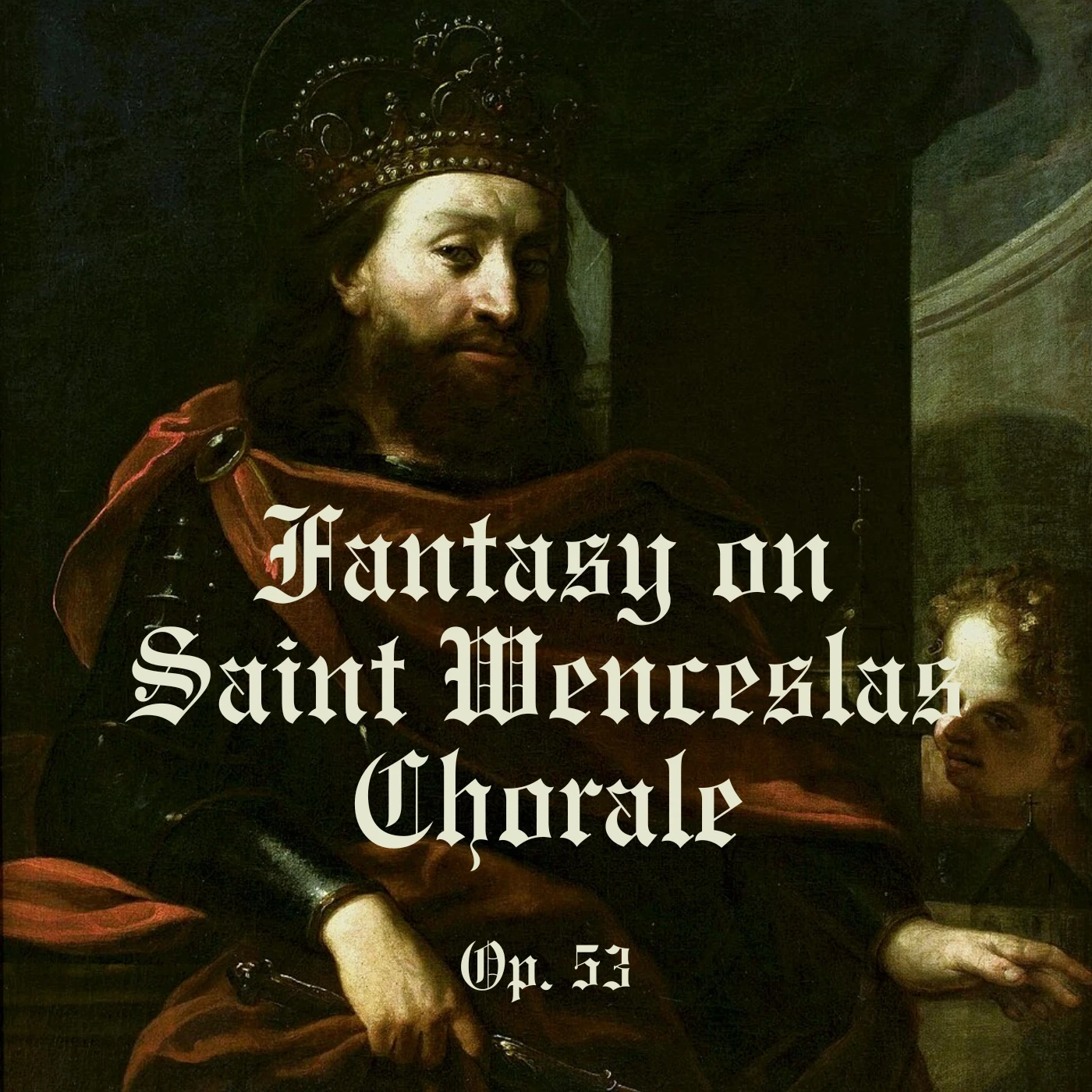
Fantasy on Saint Wenceslas Chorale
A Composer's note on Fantasy on Saint Wenceslas Chorale
St Wenceslas Day is a public holiday in the Czech Republic, and this year it fell on a Monday. I had planned to spend the long weekend on other things, but the muse had other ideas. Playing and singing through the St Wenceslas Chorale, I heard a slight reharmonisation beneath it: a chromatic line slowly sinking under the melody. It didn’t lighten the hymn. It deepened the shadow the chorale already carries. I knew at once that it belonged to an orchestra, and that the organ had to stay.
The chorale is one of the oldest songs in the Czech language, sung for more than seven centuries. Its words are a plea to the patron saint of the Czech lands: nedej zahynouti nám ni budoucím, do not let us or those who come after us perish. Josef Suk and Vítězslav Novák both wrote their own pieces on it, mostly by taking fragments of the melody and growing new music out of them. They are beautiful works; I simply took a different road. I wanted the melody itself, untouched, even as the harmony moves beneath it. The chorale is long, so it’s never heard whole, only in verses and fragments carried from one part of the orchestra to another.
The piece opens with the harmony laid bare, in great blocks of sound. A vast G minor chord, struck off by the whole orchestra. An A diminished chord, another blow. G minor again, now over B-flat, and one last blow. Out of this rises a broad progression that spells out the sinking chromatic line, and only then does the fantasy begin.
Fragments of the chorale pass through the orchestra, and the organ enters in several places, sometimes to carry the others, sometimes to steal the show. Then the music opens into G major and a theme of my own, drawn from the slow section after the first Allegro of Francis Poulenc’s Organ Concerto, a work that, like the chorale, lives in G minor. From there the two alternate: my theme, a brief return of the chorale, my theme again, and the chorale one final time.
That last appearance is the loudest the chorale ever gets. After it, the opening progression returns in a new shape and comes to rest on a massive D major chord. The strings hold a tremolo on G, the brass climb through a progression modelled on the close of William Walton’s Crown Imperial, and the piece ends in G major.
That final chord matters more to me than anything else in the piece. The story of St Wenceslas ends in murder, at the hands of his own brother. The words of the chorale are something else: a prayer for protection, sung with pride. Ending in G minor would have sounded like devastation. I wanted to end on something to be proud of.
Most of it was written in a single day, with a second day for small fixes. After Te Deum and Angelus, it’s one more step into sacred music, and Catholic music in particular, which has been drawing me in more and more.