The Artistic Journey of Petra Geršla
Explore the complete retrospective of an independent Czech composer, tracing the transition from early self-taught piano studies and minimalist explorations to mature, expansive orchestral architecture.
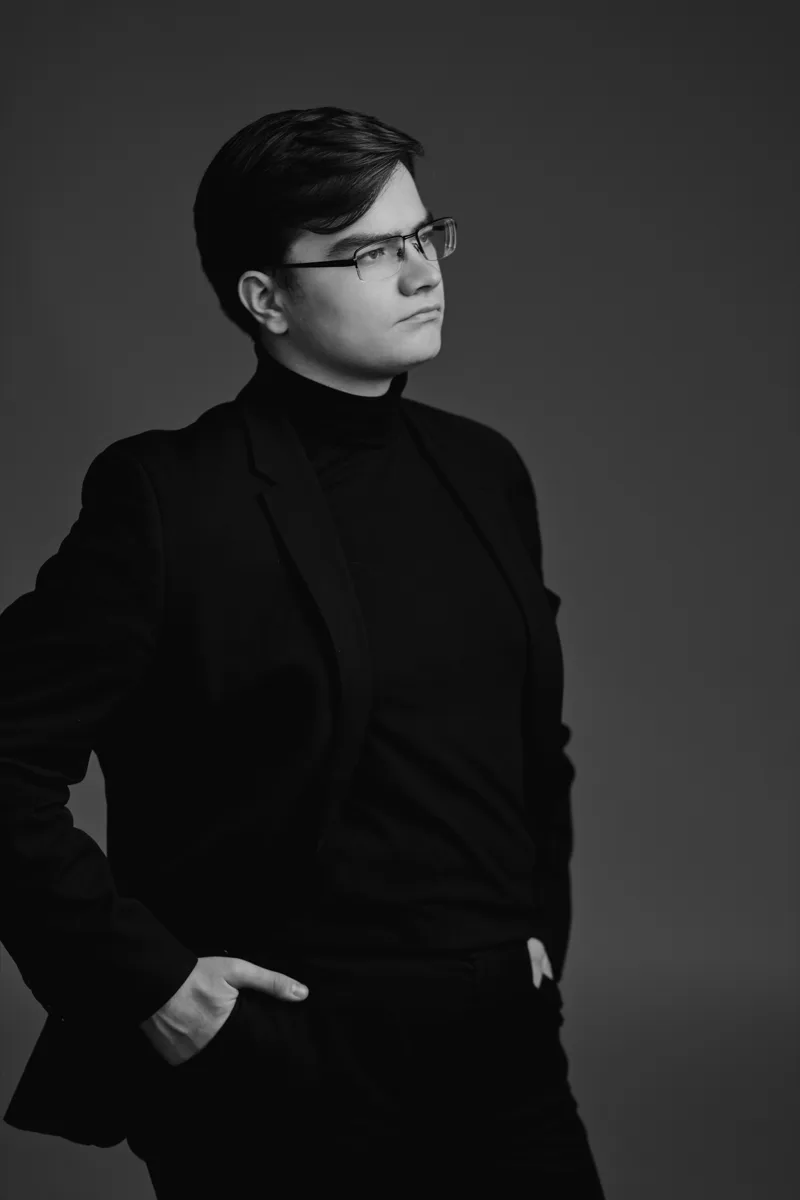
Overview & Background
Petr Geršl (*2005) is a Czech amateur composer, pianist, organist, and arranger who has created an extensive and stylistically diverse body of work in a relatively short period of time. He began composing music at the age of fifteen. He studied piano at a primary art school, which he did not complete due to disagreements with teachers and the school's management. From that point on, his musical education—both in instrumental performance and composition—has been entirely self-directed.
Evolution of Style & Milestones
First Steps & Unpublished Experiments
Geršl began writing his first compositions in 2021 after encouragement from a classmate who had heard several of his piano improvisations and suggested that he write them down. These early works, primarily solo piano pieces, were never published. Looking back, Geršl considered them overly simplistic and stylistically immature, choosing to keep them only as personal study material.
American Minimalism: Glass & Reich
His first officially released collection is Compositions (Op. 1), a set of ten solo piano pieces. This opus represents a clear stylistic exploration of Philip Glass's music, particularly his piano études. Geršl continued in this direction with Piano Sonata No. 1 (Op. 2). Alongside Glass, he was also strongly influenced during this period by another major figure of American minimalism, Steve Reich. Geršl explored Reich's compositional approach in two piano counterpoints (Op. 4 and 5) and in the now-unfinished cycle Counterpointing (Op. 3).
The Great Turning Point & Orchestral Expansion
Between 2022 and 2023, Geršl refined his technical skills through the replication of the styles of Philip Glass and Steve Reich. During this time, however, he gradually realized that in striving to faithfully recreate the works of the composers he admired, he was losing his own artistic voice. This realization led to a significant turning point in 2023, when he began composing music of a fundamentally different character and started experimenting intensively with orchestral writing.
MAJOR MILESTONE WORKSymphony No. 2 “West” (Op. 23)
His longest work to date, at over two and a half hours. Reflects frustration with the world, hope for something better, and Geršl's return to Christianity.
Symphonic Poetry & Closing Chapters
In 2024, he continued experimenting with orchestral music and further developing his compositional language. The most significant work of this period is the symphonic poem Tristan and Isolde (Op. 31), in which he musically depicts the entire story within just under eighty minutes. The piece also demonstrates a major step forward in his handling of the orchestra, both in terms of form and dramatic structure. In the same year, Geršl also made a definitive farewell to the style of Philip Glass with the works Glass Cycle (Op. 36) and The Last Figure (Op. 37), which can be understood as a conscious closing of that stylistic chapter.
Personal Voice & Finest Achievement
In 2025, Geršl continued his search for a personal musical language and further experiments in orchestral composition. A symbolic farewell to Reich's style came with the work Three Rooms (Op. 40), which concludes a long period of minimalism-inspired exploration.
HIGHEST RATED WORKWar Movie Suite (Op. 39)
To date, Geršl's finest composition, in his own estimation — combining strong dramatic expression, clear thematic development, and a mature orchestral sound pointing toward his future direction.